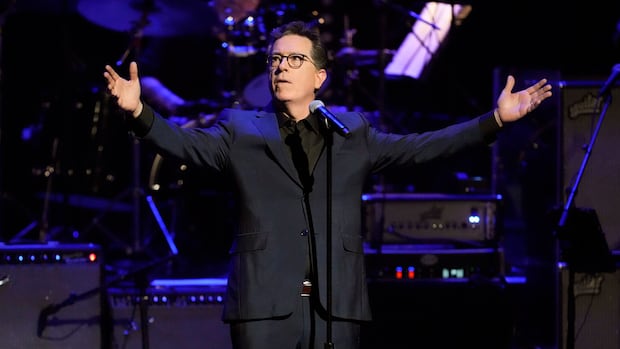
A fight between comedian Stephen Colbert and the network that airs his late night show is bringing attention to a nearly century-old broadcast requirement, known as the equal time rule.
In Monday night’s episode of The Late Show with Stephen Colbert, the host said lawyers for CBS told him “in no uncertain terms” that he could not air an interview with Texas Democrat James Talarico who is running for senate.
“Then I was told, in some uncertain terms, that not only could I not have him on, I could not mention me not having him on,” Colbert said. He then cheekily launched into a segment about the dispute and the reasons behind it.
In a statement, CBS denied Colbert’s characterization, but said the show had merely “provided legal guidance that the broadcast could trigger the FCC equal-time rule.”
The equal time rule is the requirement that mandates broadcasters to give equal airtime to all candidates running in elections, and it’s at the heart of the dispute between Colbert and his employer.
But what does that rule actually say, and how has it been enforced in the past? Here’s what to know.
What is the equal time rule?
The equal time rule is part of the Communications Act of 1934 — the act made to govern broadcast programs across the U.S. which is still in force today.
Section 315(a) — which isn’t technically called the “equal time” rule but is referred to as such colloquially — says that if one candidate in an election is given airtime on a show, then all other candidates running for the same position have to get the same chance, too. The section also has rules about political advertisements.

The goal is to prevent broadcasters from favouring one party or one set of views — but there have long been some exceptions, including for newscasts, “bona fide” interview programs, coverage of live events or documentaries.
Political interviews on talk shows have long been interpreted as being exempt because those one-on-one political interviews play a role in informing viewers.
Equal time also only applies to broadcast television and radio — so pieces on streaming services and social media aren’t covered by it at all, and the rules mostly don’t apply to cable.
Harold Feld, a communication and technology lawyer and senior vice president at freedom of expression think tank Public Knowledge, points out that hasn’t always been the case. In 1960, an interview with Richard Nixon on The Jack Paar Show triggered the equal time rule when the Federal Communications Commission (FCC) said the interview on the entertainment show didn’t count as a “bona fide” interview.
But things have changed since then. The FCC later ruled in favour of late night hosts having politicians on their show with no need to give equal time to their rival candidates, which gave way to Phil Donahue being allowed to interview then-Democratic presidential hopeful Jesse Jackson, Jay Leno’s interview with incumbent governor of California Arnold Schwarzenegger, and even Bill Clinton giving it on the saxophone on The Arsenio Hall Show.

Late Show host Stephen Colbert is accusing CBS of forbidding him to air his interview with James Talarico — a Democratic U.S. Senate candidate — citing Federal Communications Commission (FCC) rules about ensuring a level playing field during elections. Andrew Chang breaks down Colbert’s comments about the regulations, explains how they actually work, and puts it all in context with President Donald Trump’s ongoing fight against late-night TV.
Images provided by The Canadian Press, Reuters and Getty Images
A new interpretation under Trump
That interpretation seems to be changing again.
In January, the Federal Communications Commission issued new guidance saying that talk shows were not automatically exempt from the equal time rule.
“The FCC has not been presented with any evidence that the interview portion of any late night or daytime television talk show program on air presently would qualify for the bona fide news exemption,” the FCC letter read in part.
Instead, the letter said those decisions were made on a case-by-case basis, and warned that a “program that is motivated by partisan purposes” wouldn’t be exempt. FCC Chairman Brendan Carr later said during a press conference that he wasn’t worried about enforcing the rule on talk radio, which has typically been home to many conservative voices, though broadcast TV and radio are both governed by the Communications Act.
Colbert jabbed at Carr on Monday’s show for that letter, saying he believed the chairman himself — who was appointed by U.S. President Donald Trump — was motivated by partisan purposes.
“Let’s just call this what it is — Donald Trump’s administration wants to silence anyone who says anything bad about Trump on TV, because all Trump does is watch TV,” Colbert said.
In a Wednesday press conference, Carr denied that the FCC had censored Colbert’s show, and said the program could have run their interview with Talarico without violating the rule if they had chosen to air it in all states except for Texas, or if they had segments with the other candidates.
“There was no censorship here at all,” Carr said. “Every single broadcaster in this country has an obligation to be responsible for the programming that they choose to air, and they’re responsible whether it complies with FCC rules or not.”
Since issuing the letter, Reuters has reported that the FCC opened an investigation into whether ABC’s show The View violated the equal time rule when they aired their own interview with Talarico earlier this year. The commission also revived a complaint in January about an appearance by then-Democratic presidential candidate Kamala Harris on Saturday Night Live which the commission had initially dismissed.

Amy Kristin Sanders, a media law professor at Penn State University, points out that the letter doesn’t issue any new rules, just new ways to interpret the old one. But that’s worrying to her given how responsive media companies like CBS seem to have been to what she sees as such a small amount of pressure.
“What we’re seeing here is major media corporations essentially fall at the knee of the FCC without really any real regulatory force,” Sanders said.
“This administration’s been really, really good at using this soft regulatory pressure to get major media players and major news organizations to fall into line … and it’s a real, real danger to freedom of expression in the country.”
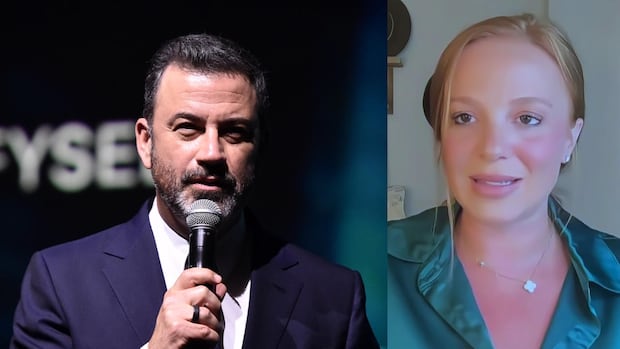
Former entertainment reporter Ali Carbone says she is worried that the U.S. is entering a ‘dangerous place of a controlled media’ after Jimmy Kimmel Live! was pulled from the air. ABC said on Wednesday it will indefinitely stop airing the show after remarks the late-night host made about the reaction to Charlie Kirk’s assassination came under harsh criticism from the head of the U.S. Federal Communications Commission.
Does the rule still matter?
Regardless of the fight about what to put on terrestrial television, the interview is still available to view on YouTube.
It’s doing well, too — the segment has more than 6.2 million views on the platform, while most of the other interview segments on the channel have a few hundred thousand views.
Commotion with Elamin Abdelmahmoud26:59Colbert cancelled, Eddington and the viral Coldplay couple
But is the rule obsolete if it doesn’t apply to digital platforms where so many people get their information? Feld says not quite, because there are many Americans who still rely on broadcast radio and TV to get their information.
Plus, they were created for a good reason that still has value, Feld says — to prevent certain ideas from being shut out of the media.
“If anything, I would say … we ought to expand it to other media that serve the same purpose,” Feld said.
Feld worries that going forward, the FCC’s recent letter will have a chilling effect, making broadcasters across the board more reluctant to have political interviews on their airwaves at all — a big loss, he says, at a time when many local news organizations are struggling and some politicians are bowing out of debates.
“[These interviews have] become really very important to people trying to weigh who to vote for — or even, frankly, for a lot of our low-information voters, to even know who’s running in an election,” Feld said.