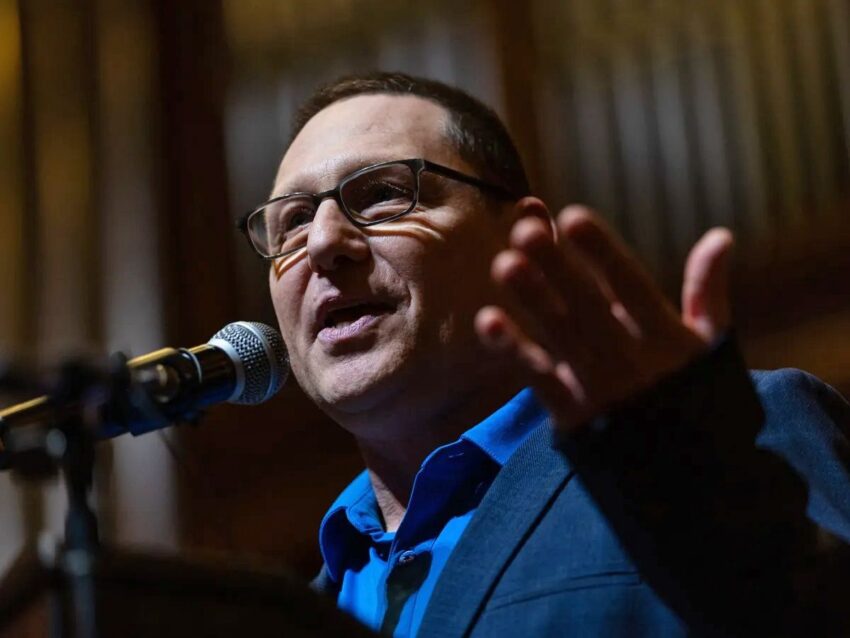
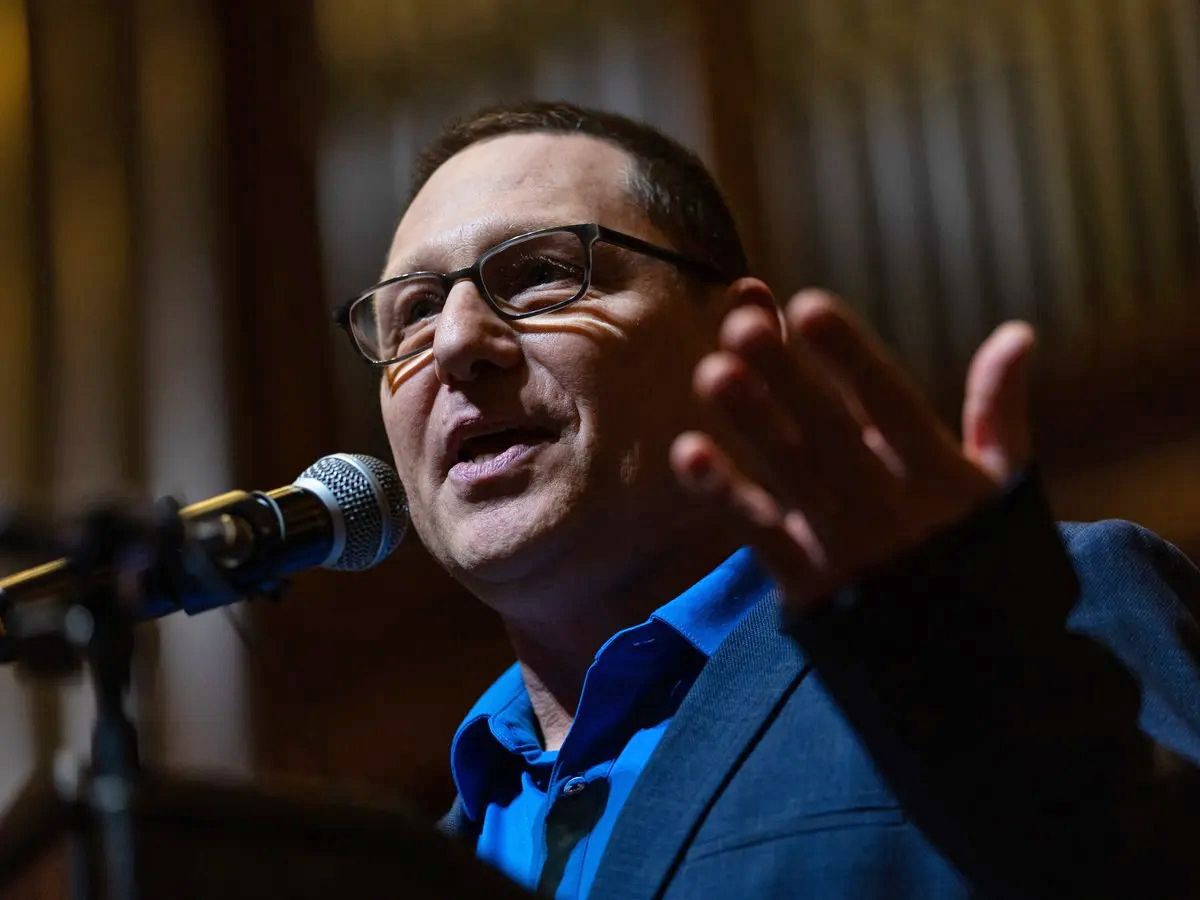
OTTAWA — Filmmaker and journalist Avi Lewis is heading into this weekend’s NDP leadership convention as the clear favourite to win it all.
Lewis, a loud and proud eco-socialist slinging a host of outside-the-mainstream policy proposals — such as government-owned grocery chains and a public bank run by Canada Post — has dominated both fundraising and the public conversation (albeit a largely ignored one) heading into the Mar. 29 leadership announcement in Winnipeg.
While there’s been little reliable polling done through the six-month leadership campaign, Lewis put up
a $1.23-million fundraising haul
with a month left to go in the race, an NDP leadership race record and slightly more than the other four candidates in the race combined.
A deeper dive into the numbers reveals that Lewis’s fundraising dominance is powered by small donations,
. Some six in 10 Canadians who’ve opened their wallets to support an NDP leadership candidate have contributed to Lewis’s war chest.
Lewis has also cashed much bigger cheques from well-known progressive figures like former CUPE Ontario president Fred Hahn, his biggest donor,
celebrity environmentalist David Suzuki
and Life of Pi author Yann Martel.
Fundraising totals have tracked closely to vote counts in the
last two NDP leadership elections

, putting Lewis on course for a first-ballot win on Sunday.
But while Lewis is likely cruising to a coronation in Winnipeg, this doesn’t mean that the party’s various factions are unifying behind his leadership. Lewis has long been a polarizing figure in party circles, and is likely to remain so long after the biodegradable confetti has been swept from the convention floor.
National Post spoke with multiple NDP insiders, including a former federal leader and two former provincial cabinet ministers, who say they’re concerned about Lewis’s ability to hold together the party’s traditional coalition of progressive urbanites and blue-collar workers concentrated in industrial and resource communities.
Thomas Mulcair, who led the NDP from 2012 to 2017, said he’s expecting Avi Lewis to win on the first ballot, but he’s doing so with dread.
Mulcair said that Lewis’s
hardline stance against fossil fuels
will make a Lewis-led NDP unelectable in remote resource communities where the party has historically been competitive.
“It’s one thing to say you’re going to do the responsible thing on climate change and meet our obligations under the Paris Accord,” said Mulcair. “But (Lewis) goes so much further in putting forward something that is clearly going to cripple Canada’s economy.”
Lewis says he’s opposed to all new fossil-fuel development
— including Indigenous-led liquified natural gas projects
— and is running on a Green New Deal to decarbonize Canada’s economy.
“What Lewis is proposing might be pleasing to a very tiny base, mostly in the large cities, but it’s not going to resonate across the country, where resource extraction has always been a key component of our economy,” said Mulcair.
Lewis and his wife, author and public intellectual Naomi Klein, made life difficult for Mulcair, then leader of the official Opposition, by
, a radical document calling for the elimination of fossil fuels, a month before the fall 2015 election.
The two tried unsuccessfully to force the anti-fossil fuel manifesto through as official NDP policy at the party’s 2016 convention in Edmonton. The couple’s
deeply embarrassed the host Alberta NDP, which just one year earlier had been elected to its first ever term in government.
Lewis was unrepentant when pressed on the Leap Manifesto debacle at last month’s
English-language leadership debate
in British Columbia, insisting that he and Klein did everything above board, including keeping the Alberta section in the loop.
“I think I’m the same New Democrat I’ve always been,” said Lewis, reflecting on whether he’d grown from the decade-old experience.
One New Democrat who hasn’t forgotten about the Leap Manifesto fallout is Shannon Phillips, who was Alberta’s environment minister when the document was foisted on the Edmonton convention. Phillips said in a
that the manifesto badly compromised her government’s strategy of obtaining social licence for new oil and gas projects via industrial carbon pricing and other mitigation policies.
She told National Post she was disappointed to hear Lewis express no contrition at all over the Leap Manifesto at the last leadership debate.
“I didn’t see any change in tone, affect or self-reflection in that debate,” said Phillips, who has endorsed Lewis’s chief rival, Edmonton NDP MP Heather McPherson, in the leadership race.
Phillips added that it was “demonstrably false” for Lewis to suggest that his approach to disagreements between the federal party and provincial sections is to deal with them in an “adult manner that constitutes picking up the phone.”
She said she’s been waiting a decade for Lewis to call her to clear the air about the 2016 Edmonton convention.
“Avi’s had my phone number since at least 2005 or 2006,” added Phillips.
Phillips got a painful reminder of the affair last week, when a
clip from a 2020 YouTube video
surfaced showing Lewis and Klein laughing about her losing her post as environment minister, after the Alberta NDP was defeated in 2019.
She said at the time that
from both Lewis and Klein. As of Friday, neither of them had reached out to her.
The Alberta and Saskatchewan sections of the NDP are noticeably steering clear of the Winnipeg convention with Lewis likely to emerge as leader.
“As the Saskatchewan legislature is currently meeting to consider Premier (Scott) Moe’s billion-dollar deficit and bad news budget, Carla and her team will not be in Winnipeg,” a spokesperson for Saskatchewan NDP leader Carla Beck said in an email.
Alberta NDP leader Naheed Nenshi was more blunt
in late February.
“The Alberta NDP will have nothing to do with the Leap Manifesto cliff jumpers,” said Nenshi.
Nenshi
championed a successful resolution
at last year’s Alberta NDP convention to allow provincial members to opt out from joining the federal party and says he’s not a member of the federal NDP.
One provincial NDP leader who will be in attendance in Winnipeg is hometown boy Wab Kinew, the premier of Manitoba, who will be delivering short introductory remarks on Friday. Ontario NDP leader Marit Stiles will give an address on Saturday.
Selena Robinson, a former British Columbia NDP finance minister, says she sees Lewis taking the NDP in a direction that ties urban progressivism with grievance-driven anti-Western politics, pointing to his recent activism
.
“It’s appealing to this sense out there that capitalism is evil and Western society is evil, so let’s burn it all to the ground,” said Robinson.
Robinson said she sees shades of Swedish celebrity protester Greta Thunberg in the way Lewis has pivoted from activist climate politics to anti-Israel activism in the wake of the Oct. 7, 2023 attacks in southern Israel.
“It’s obvious that Avi (Lewis) is cut from that same cloth (as Thunberg),” said Robinson. “He went from the environment, the environment, the environment, to ‘Israel’s evil’ because that’s where the energy was.”
“That’s about ego, it’s not about issue,” Robinson added.
Mélanie Richer, formerly a senior advisor to former NDP leader Jagmeet Singh, said she doesn’t see grievance politics driven by foreign matters like the Israel-Hamas war in Gaza, as salient enough to reach a broad cross-section of Canadians.
“I want to be careful in how I talk about (the Palestine issue) because it’s obviously really important and life-or-death for a lot of people, but the problem when you focus exclusively on an issue happening outside of Canada is a lot of folks, while they do care about it, it’s not the number one thing they’re voting on,” said Richer.
Richer added that successful urban case studies, like the recent election of pro-Palestine democratic socialist Zohran Mamdani as mayor of New York City, aren’t necessarily a viable template for the NDP to follow to rebuild a national coalition.
“While (this approach) may have been successful in New York, it’s hard to test how it can be successful country-wide,” said Richer, noting that most of the areas where the NDP has historically done well have been more rural and suburban settings.
“So how do you then stay competitive in those areas while building support in the urban centres is, I think, a massive question,” said Richer.
National Post
rmohamed@postmedia.com
Our website is the place for the latest breaking news, exclusive scoops, longreads and provocative commentary. Please bookmark nationalpost.com and sign up for our daily newsletter, Posted, here.