The death toll in the Philippines from Typhoon Kalmaegi rose to 114, with another 127 people still missing, the disaster agency said on Thursday, as the storm that devastated the country’s central regions regained strength as it headed toward Vietnam.
As Kalmaegi moved over the South China Sea ahead of its landfall in Vietnam, it was forecast to impact several central provinces in the country, including key coffee-growing areas, where the harvest season is currently underway.
The country’s financial hub, Ho Chi Minh City, faces a heightened risk of severe flooding as high tides would coincide with the expected heavy rainfall from the typhoon, forecasters warned.
High tides are expected on the Saigon River, while parts of the city could see up to 100 millimetres of rain, which authorities warned could inundate low-lying areas.
In Vietnam’s Gia Lai province, some 350,000 people were expected to have been evacuated by the middle of the day as authorities warned of heavy rains and damaging winds that could cause flooding in low-lying areas and disrupt agricultural activity.
Authorities were mobilizing thousands of soldiers to assist with potential evacuations, rescue operations and recovery efforts.

Vietnam’s aviation authorities said operations at eight airports, including the international airport in Da Nang, are likely to be affected. Airlines and local authorities have been urged to closely monitor the storm’s progress to ensure passenger safety.
Vietnam’s ancient town of Hoi An and the nearby city of Hue were already in recovery mode after flooding that began at the end of last week, killing at least 35 people.
State of emergency declared in Philippines
In the Philippines, the typhoon’s onslaught affected nearly two million people and displaced more than 560,000 villagers, including nearly 450,000 who were evacuated to emergency shelters, the Office of Civil Defence said. President Ferdinand Marcos Jr. declared a state of emergency for the country on Thursday.
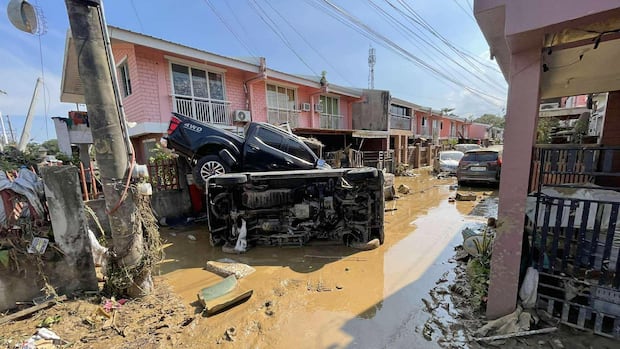
In the Philippines’ hardest-hit province of Cebu, the scale of the destruction became clearer as floodwaters receded to reveal flattened homes, overturned vehicles and streets choked with debris.

More than 200,000 people were evacuated in the Philippines ahead of Kalmaegi hitting on Tuesday. Some have returned to find their homes destroyed, while others have begun the arduous cleanup, scraping mud from their houses and streets.
“The challenge now is debris clearing … These need to be cleared immediately, not only to account for the missing who may be among the debris or may have reached safe areas but also to allow relief operations to move forward,” Raffy Alejandro, a senior civil defence official, told DZBB radio.

Even as Typhoon Kalmaegi, locally named Tino, exited the Philippine monitoring zone, weather forecasters were tracking a brewing storm east of Mindanao that could strengthen into a typhoon, raising concerns for potential impacts early next week.
The devastation from Kalmaegi, the 20th storm to hit the Philippines this year, comes just over a month after a magnitude 6.9-earthquake struck northern Cebu, killing dozens and displacing thousands.